
Walter Werzowa
Composer, music inventor, educator, nonprofit founder
- Background
- Architecture studies, synthesiser pioneer, collaborations with Falco and Spielberg
- Current Focus
- AI-Beethoven Symphony project, Health Tunes (music for health nonprofit), teaching
Executive Summary
Walter Werzowa calls himself an inventor rather than a composer. Everything begins with listening — to the problem, the audience, the concept — before a single note gets written. His career spans the Intel melody (which he describes not as composition but as construction, "almost like a mathematical equation"), film scoring, synthesiser pioneering in central Europe, and a nonprofit bringing music into communities as a healing modality. Across all of it, a single conviction holds:
With music, you're never alone. It feels like there's something or somebody out there, bouncing back and forth. It doesn't matter if it's human-made or robot or AI-made. It has life.
The Beethoven project: neither could do it alone
The AI-Beethoven Symphony project, sponsored by Deutsche Telekom, set out to answer a specific question: how can technology and human creativity coexist and bring each other up a notch? The goal was never to replace Beethoven or claim equivalence. It was to demonstrate that neither AI nor human could do in isolation what they achieved together.
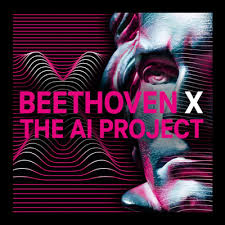
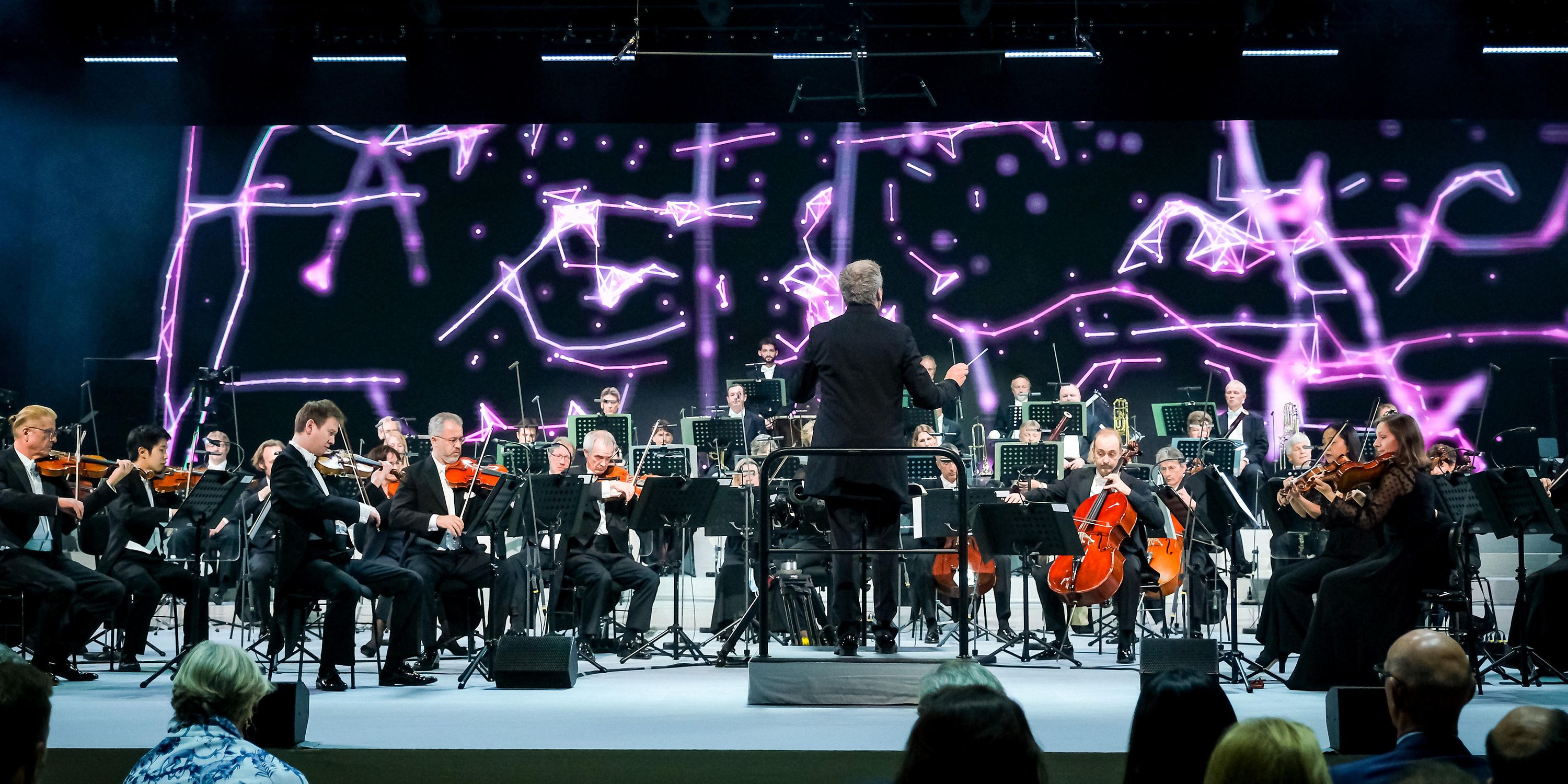
The pivotal moment came early. Walter arrived with academic books on counterpoint and music theory, expecting the AI to absorb the rules. His collaborator Ahmed Elgammal refused. They would train only on Beethoven's scores — the rule-breaking and genius were already there, embedded in the music itself.
This moment changed my point of view to AI 100%. Suddenly it all made sense — how respectful AI can be, and how important the training material is. How respectful AI can be, speaking eye to eye with Beethoven. No human can do this now.
Working daily, Walter received 100 to 200 musical snippets. Some were empty, off-putting, with no soul. Others were "incredibly powerful and moved me to big emotion." The range was always present. Most striking: the AI, trained only on Beethoven and his predecessors, produced a theme that sounded unmistakably like Schubert. Mathematically it made sense. Emotionally it was astonishing — the system had found something at the edge of its training that neither Walter nor the algorithm had consciously aimed for.
Recovering creative joy
The second part of Walter's life has a mission: helping people recover the creative joy lost somewhere between childhood and adulthood. As children, he says, we eat creative, sleep creative, run creative. Then family, education, and social pressure accumulate. A single remark at a vulnerable moment — an uncle turning around in a car, a teacher's offhand comment about a drawing — and people stop singing, stop painting, stop writing poetry forever.
This isn't abstract concern. He worked with Spielberg, composed one of the most-heard melodies in history, sat in Hans Zimmer's studio — and Zimmer confided he was scared he had no ideas for his next film.
Maybe that's why classical composers like Beethoven were stern and not really happy. There are not that many pictures of artists which are joyous and smiling.
The insecurity doesn't dissolve with success.
AI enters this story as potential liberator. Working on a laptop, you might dare to let go of barriers you'd never release in front of another person.
I would be less embarrassed to be not that creative with AI than if working on a project with another person where I have to present.
The tool lowers the stakes of exposure, creating conditions where people might try again.
The unspoken audience
Walter describes a phenomenon he's observed repeatedly. He composes something, refines it over days, feels satisfied. Then he asks someone to sit in the room — not a musician, not someone who will say a word. Just a presence.
In that moment, if there's another person in the room, I feel so many things differently and find things I need to refine. This is unspoken. There is audience here and with the audience you have a different experience.
He connects this to the Princeton Global Consciousness Project — research suggesting that groups with shared intention can influence probabilistic outcomes in measurable ways. Whether or not one accepts the science, the phenomenon he describes is real to him: human sensitivity to presence changes perception. The audience is never truly absent from the creative act.
We have the audience always on our shoulders or belly. We can't truly separate ourselves from them.
This shapes his view of composition's purpose. Mozart wrote for a king with five violins and a flute. Contemporary composers write from lovesickness or longing. But the impulse is the same:
Many composers are composers because they have challenges in communication and find a different way to communicate. When I write my lovesick symphony, it is because I want to communicate that with you because I don't find the words.
Dreaming, architecture, and the brain-controlled orchestra
Walter dreams solutions. Music arrives in sleep and he brings it into waking reality — a process that took decades to master but proved possible. He gave up expecting the dream version and the realised version to match exactly. They're different realities. In dreams, he is director, writer, and actor simultaneously. Once the outer world enters, things shift — but the dream remains the generative source.
His architecture background runs through everything. Pythagoras connected harmonic ratios to spatial proportion; Walter sees the same language operating in both fields. Texture, structure, the relationship between parts and whole — these aren't metaphors borrowed across disciplines but the same underlying principles expressed differently.
His dream AI system extends this thinking into live performance. He imagines a device he could use as conductor — inputting atmospheric textures, emotional qualities, sonic references — that works in real-time with an orchestra to find sounds appealing to musicians, conductor, and audience simultaneously.
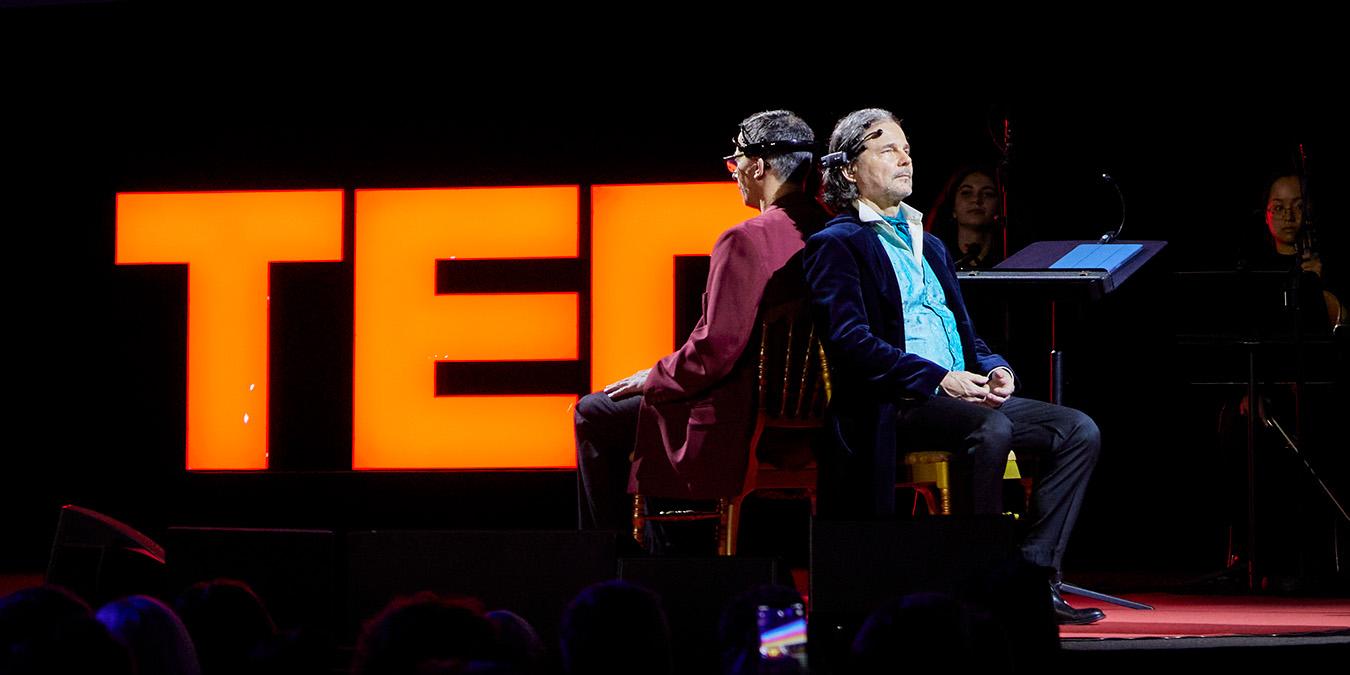
Maybe this thing is also controlled somehow directly with my brain and have this being an orchestra instrument.
Not a replacement for the orchestra but a new instrument within it, responsive to emotion and audience feedback in ways no existing instrument can be.
Health Tunes and the Mozart effect
Walter's nonprofit Health Tunes pursues music as an affordable, cross-cultural healing modality — particularly for communities without access to expensive medical interventions. His focus includes Mozart's Sonata K448 for two pianos, which reduces seizures in epilepsy by up to 75% in clinical studies. Nobody fully understands why.
Walter has his own intuitions and wants a research partner to investigate whether the underlying principles could be identified and applied to newly composed music. AI's speed of analysis makes this kind of research newly feasible — a meaningful project, he says, and a needed one.