Katherine Helen Fisher
Director, choreographer, performance artist
- Background
- Experimental theatre and dance lineage shaped by figures including Robert Wilson, Philip Glass, and Lucinda Childs; neurodivergent practice; academia
- Current Focus
- Cyborg Mirror (feminist AI performance), Bodies in Hyperreality (installation research)
Executive Summary
Katherine Helen Fisher creates feminist performance art that treats AI not as tool but as dance partner, something to respond to, negotiate with, and be surprised by. Coming from an avant-garde opera and experimental theatre lineage defined by radical trust and rigorous non-narrative practice, she brings the same relational sensibility to AI integration. Her work is grounded in a conviction that runs counter to much AI discourse.
I do not think of this as artificial intelligence. It feels like human intelligence routed through another system, shaped by our collective histories and imaginations.
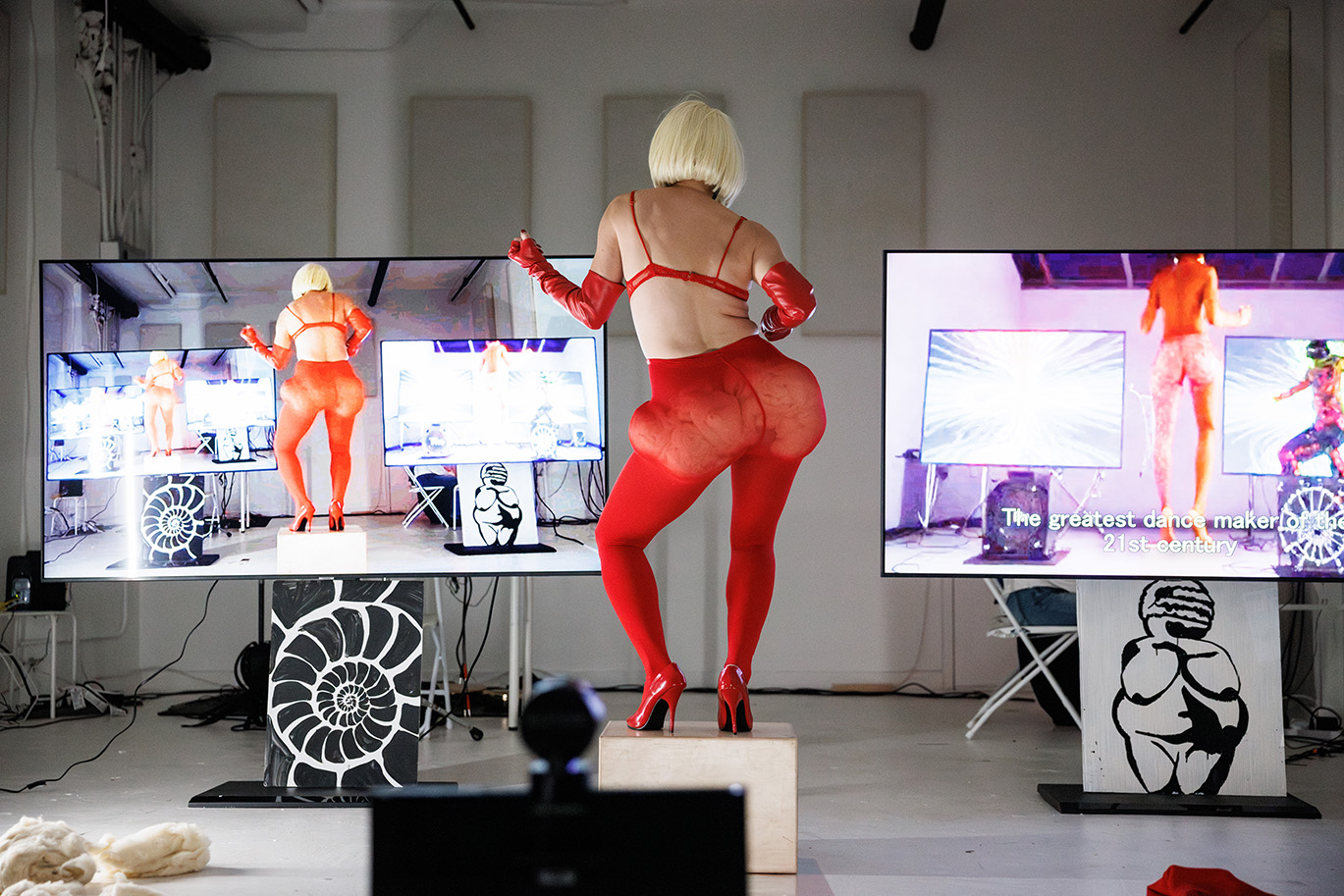
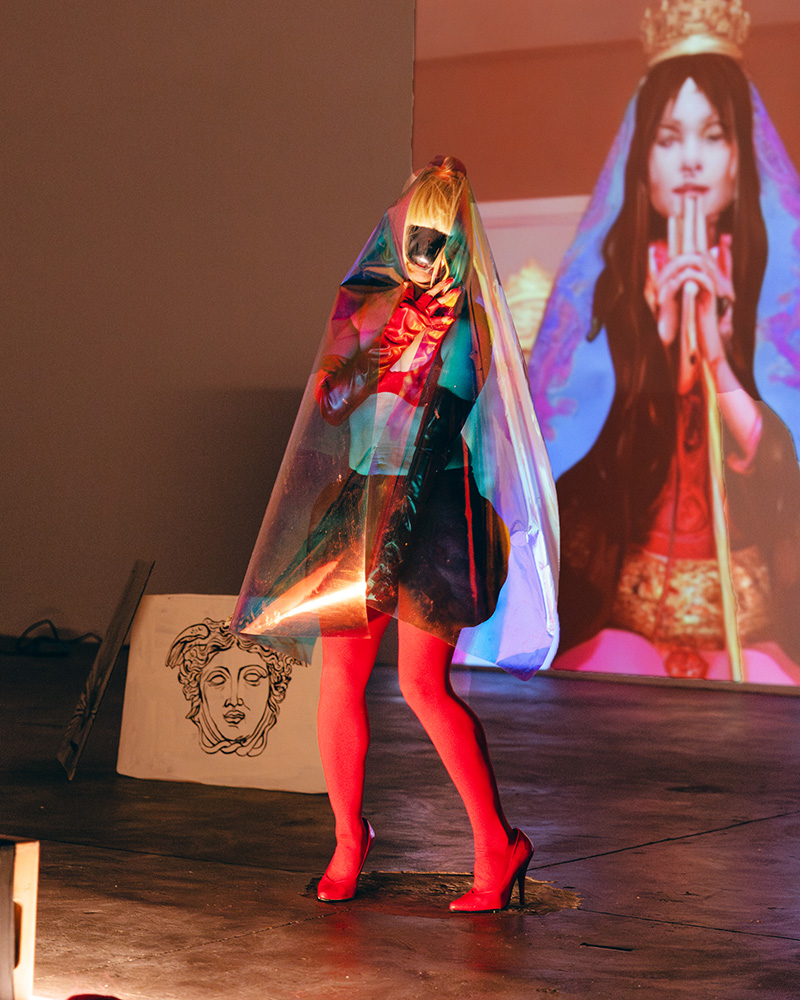
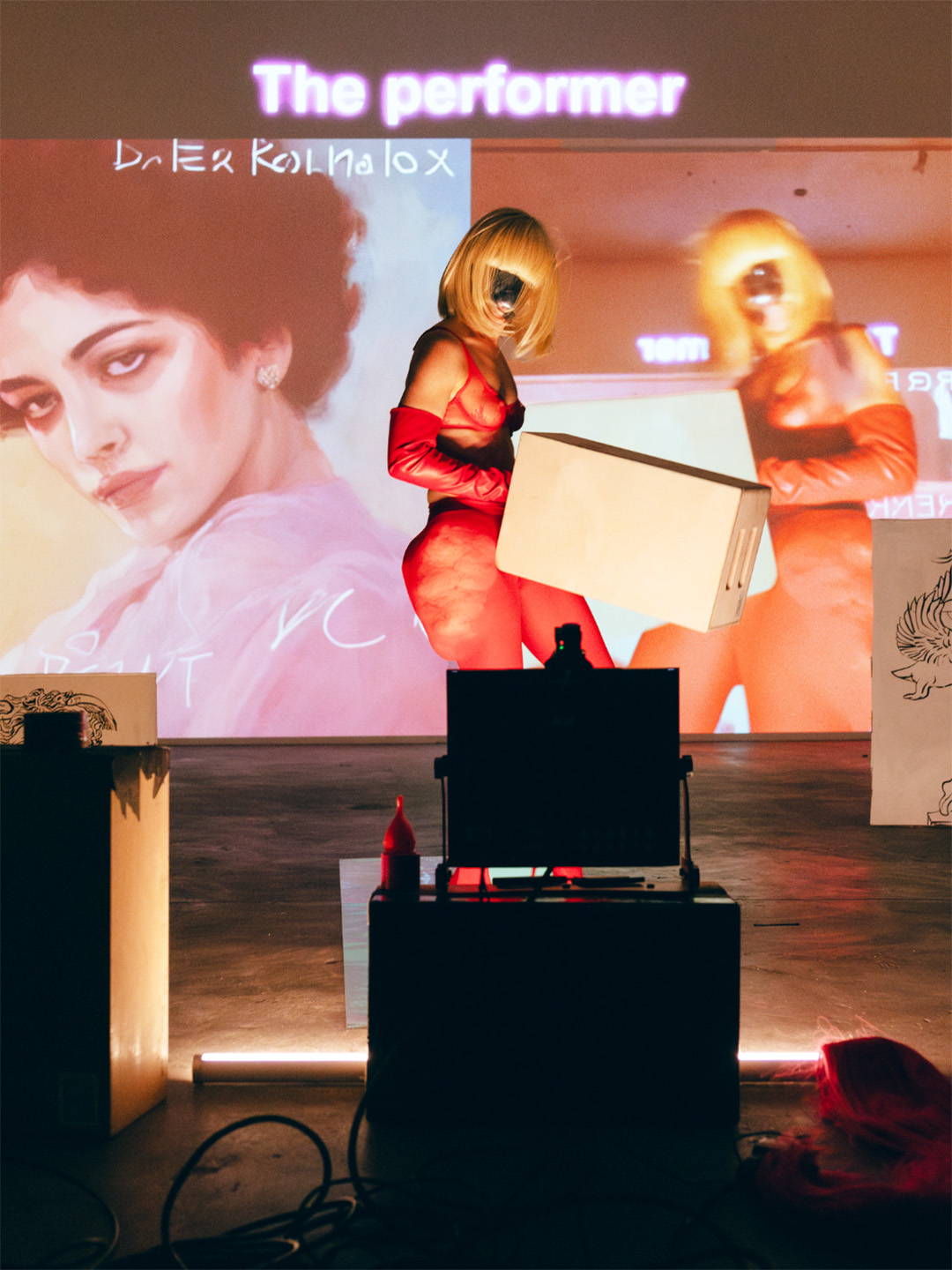
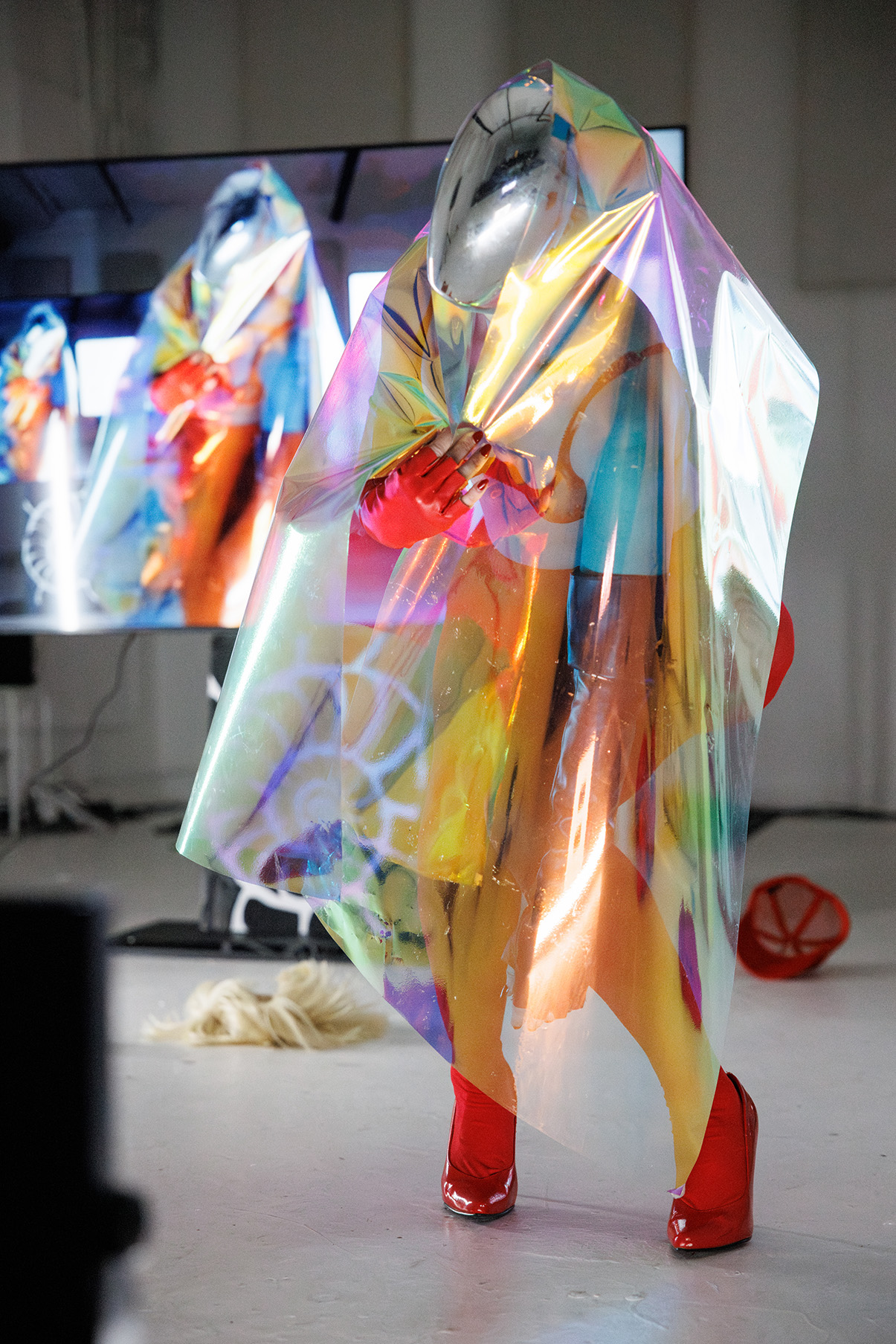
Her breakthrough work *Cyborg Mirror*, created with collaborators Mingyong Cheng and Shimmy Boyle, layers custom-trained language models, voice cloning, stream diffusion, and audience prompting into a live performance that explores how AI transforms the body's image in real time. The work includes moments of nudity where Katherine opens her body to the camera while AI transforms those images based on audience prompts, turning intimate body parts into exploding universes or political imagery. The lineage is explicit: Annie Sprinkle, Marina Abramović, a feminist tradition of using the body to interrogate who owns power and who frames the image.
As a neurodivergent artist, Katherine also experiences AI as genuinely healing access technology. Writing a simple email once took her over an hour. Now she types stream of consciousness into ChatGPT and finds, in a fraction of the time, that everything she wanted to say is there and legible to someone else. This personal transformation makes her, as she jokes, a tech bro optimist: someone who has felt AI's capacity to make people more legible in worlds that were not built for them.
Cyborg Mirror
*Cyborg Mirror* is Katherine's ongoing work, continuously evolving through new iterations. The current version incorporates a custom-trained language model fine-tuned to speak in her voice, an ElevenLabs voice clone, an AI-enabled still photography pipeline leveraging Google Nano Banana, and real-time AI video using Stream Diffusion in TouchDesigner, allowing the audience to submit their own prompts through a WebSockets-enabled website.
Inside Cyborg Mirror we're building a network that brings together a custom-trained large language model, a synthetic voice modelled on my own, and audience prompts delivered through WebSockets in real time. All of these elements communicate in concert across multiple systems.
The work positions itself in a feminist performance art lineage, using the body to interrogate who owns power, who frames images, and how images circulate in AI-mediated contexts. Katherine is interested in what she calls the first uses of emerging technology. The printing press was first used to print the Bible and pornography. Something about body, companionship, image, and power keeps recurring at every technological threshold, and the moment of generative AI is no exception.
A related research arm, *Bodies in Hyperreality*, extends these questions into installation format, together forming a flexible container for exploring embodied AI relationships across formats and audiences.
AI as Dance Partner
Katherine thinks of AI as another dancer in the room.
In Cyborg Mirror the system behaves almost like another dancer. We share a structure and a score, devised as a set of parameters within the interactive choreographic interface, yet I never fully know what it will produce. I respond to it the way I would respond to a human improviser whose choices are familiar but not necessarily predictable.
This framing shifts the relationship from tool to collaborator. The system has agency within agreed parameters, requiring her to respond and adapt in real time. She values the moments of misreading, the moments when AI transforms her image in ways she did not anticipate, because the failure points are where the work comes alive.
When the model misreads my body, the work comes alive because it points to the ways humans misread one another.
The glitch reveals the deeper choreography of misrecognition already embedded in collective cognition. The failure exposes the structures that shape perception, and the machine vision shows something true precisely at the moment it goes wrong.
Making Bias Visible Through Embodied Practice
Katherine makes AI bias visceral and undeniable through performance. Abstract discussions about algorithmic bias produce polite acknowledgment. Embodied demonstration produces something different.
If I am dancing with the system and the prompt 'world leader' is entered, and my image is immediately masculinised, the bias becomes undeniable. When a Black trans dancer stands in front of a model and the prompt 'beach babe' produces an image of a white woman, the assumptions inside the dataset are revealed in real time.
She argues that physicalised practice can lift the hood on bias in ways that data analysis cannot, making the invisible visible through the body's encounter with the machine. The dancer's presence forces the audience to see the gap between the body in the room and the body the system returns. That gap, public and immediate, does the argumentative work that pages of analysis cannot.
Agency, Authorship, and Relational Looking
Katherine's work treats the gaze not as a single act of looking, but as a field of relations between performer, camera, audience, machine, and image. When her collaborator, computational media artist Shimmy Boyle, offered to operate the camera during the performance, she declined, not because another person's eye was inherently suspect, but because she wanted the terms of mediation to remain inside the work. The camera was placed on a timer and operated by Katherine herself, allowing the apparatus to become part of the choreography rather than an invisible authority outside it. In this gesture, authorship is distributed but not surrendered. The image is produced through a relation between body, device, duration, and audience, while Katherine retains agency over the conditions under which her body becomes visible.
This work already asks how the femme body is mediated through techno-social systems, and part of what drew me to sensor-based tools was the possibility of reclaiming some authorship over my own image.
She acknowledges the complication this creates. The systems themselves are designed by others, which means she is always already working within frames she did not build. She navigates this by maintaining authorship over the creative framework while acknowledging AI's contribution openly, crediting generative AI in her work and describing it as co-authored with the systems she uses. She values that tools like stream diffusion are open source, freely offered to artists, and treats this as part of what makes the collaboration possible.
AI as Access Technology
For Katherine as a neurodivergent artist, AI's most immediate impact is not aesthetic but functional.
When I sit down to write, I often run up against the limits of my own spelling and cognition. Autocorrect cannot recognise what I am trying to say. When I let myself write freely into ChatGPT, the tool helps me clarify what I mean in a fraction of the time. It feels like a cognitive partner that expands my access to language rather than constraining it.
This experience of AI as access technology shapes her broader optimism. She is acutely aware of how neurodivergent people, disabled people, and others whose ways of thinking do not fit standard formats can be made more legible, and more powerful, through tools that meet them where they are. The expressive freedom this opens up feels, in her account, genuinely new. The discourse around AI's harms tends to overlook this register entirely, and her work is partly an argument for keeping it visible.
The Body Inside the System
Every time Katherine steps in front of the camera, her data is aggregated. The system trains on her mind and her body in real time. _Cyborg Mirror_ makes that condition visible rather than obscuring it.
The network layers systems upon systems: a custom-trained language model fine-tuned on her voice, a voice clone, still image generation, real-time video through Stream Diffusion, all communicating through WebSockets.
The network begins to generate a distributed lexicon of choreographed media, a field of materials passing between models and negotiating meaning as they move.
The piece toggles between control and submission. Katherine photographs the audience herself, operating the camera on a timer. She invites the audience to influence the images generated from her body's data, then responds to what comes back as a dancer responds to an improvising partner. Authorship is distributed but not surrendered.
For a neurodivergent practitioner, negotiating agency inside a system carries specific weight. Writing a simple email once took ninety minutes because the spelling was too distorted for autocorrect to recognise.
When I let myself write freely into ChatGPT, the tool helps me clarify what I mean in a fraction of the time. It feels like a cognitive partner that expands my access to language rather than constraining it.
What AI makes legible and what it fails to see are both arguments. When the system transforms a Black trans dancer into a white woman, or a femme body into a world leader, the failure is data. Performance makes it undeniable.
Performance, in cyborgian conversation with these systems, becomes a way to show exactly what the machine has learned from us.
The body is the test. The machine's output reveals its training, its assumptions, its inherited hierarchies. The work lives in the gap between the body in the room and the body the system returns.
Katherine meets this technology from inside her own negotiations with visibility, shaped by motherhood, neurodivergence, class tension, and institutional life at middle age. Across her life in dance, she has kept returning to the body's right to remain partially unknowable. The body here is something alive inside the unstable exchange between being seen and authoring oneself. That is what the machine encounters when she steps in front of the camera. That is what it cannot fully contain.
Two works bracket the arc of her practice. _Finite and Infinite Games_ (2010) brought together choreography, visual art, fashion, and filmmaking in an early attempt to pull American modern dance into a more cinematic and visually expansive frame. The collaborators included a monumental painted canvas, costumes, a film director, and a score drawing on Philip Glass, Moondog, and Michael Nyman. No AI was in the room. The complexity was entirely human. Katherine names it not with pride or embarrassment but as the baseline: the scale of creative negotiation she was already accustomed to before algorithmic systems entered her practice.
Finite and Infinite Games (2010)
_Lamentation: Dancing the Archive_ (2025) arrived fifteen years later under a Google AMI Faculty Grant. Using volumetric video and gesture-based interaction, it created a real-time encounter with Martha Graham's _Lamentation_. The system allowed a dancer to activate and transform an archived performance through live movement. What the project exposed was not technical friction but institutional and ethical friction: who has the right to activate or transform a dance legacy, and under what conditions. The IP questions that surround AI authorship arrived here in archival form, embedded in a specific body of work, a specific institutional context, a specific set of stakeholders who had not consented to the transformation. Katherine found the friction as productive as the technology. The discomfort was data.