
Julie Freeman
Artist working with data from living systems; sound sculptor; interactive installation artist
- Background
- Thirty years of practice in art and technology; learned C programming pre-internet; creates frameworks translating natural systems into experiential encounters
- Current Focus
- Physical sound sculptures (Sonaiforms), tactile data experiences, low-resource AI experimentation, environmental critique
Executive Summary
Julie Freeman is a critical practitioner who deliberately moved away from screen-based work in response to generative AI's proliferation. Her 2023 pivot from data-driven animations to physical sound sculptures was not a retreat from technology but strategic repositioning toward experiences AI cannot easily replicate. After thirty years making computational art, she maintains clear boundaries. AI serves instrumental functions but remains, in her phrase, computation at her beck and call, never reaching the status of collaborator regardless of how sophisticated it becomes.
Her practice centres on translation rather than generation. Data from fish, naked mole rats, glaciers, and microbes is transformed into tangible, beautiful encounters. She positions herself as maker and reframer, synthesising collaborators' technical or visionary concepts into experiential reality. The curatorial sensibility extends to her AI experiments, where she deliberately used low-resource models to critique AI's environmental extractiveness while exploring its creative limits.
Her position on authorship reveals sophisticated thinking. She readily attributes co-authorship to living systems whose data makes work possible. She resists extending this to computational systems. Even a hypothetical AI trained on her entire practice would remain a tool, not a collaborator. The reason is three decades working with code.
I can't get past the fact that we're seeding all this from rule bases and data sets.
Her creative philosophy, throughout, is that process is creativity. She will not farm out making to AI because ideas often only arrive once execution has started.
The 2023 Pivot
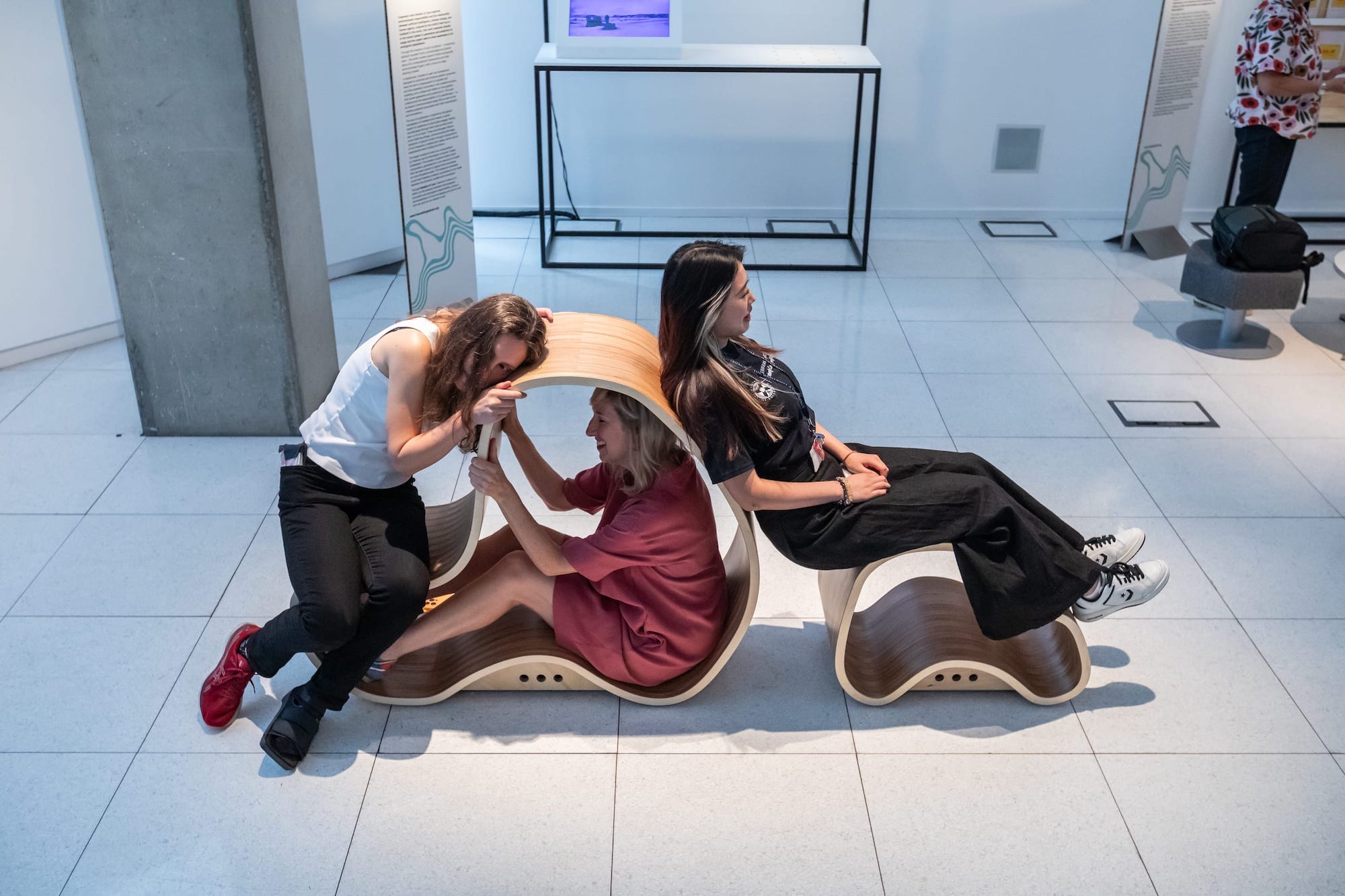
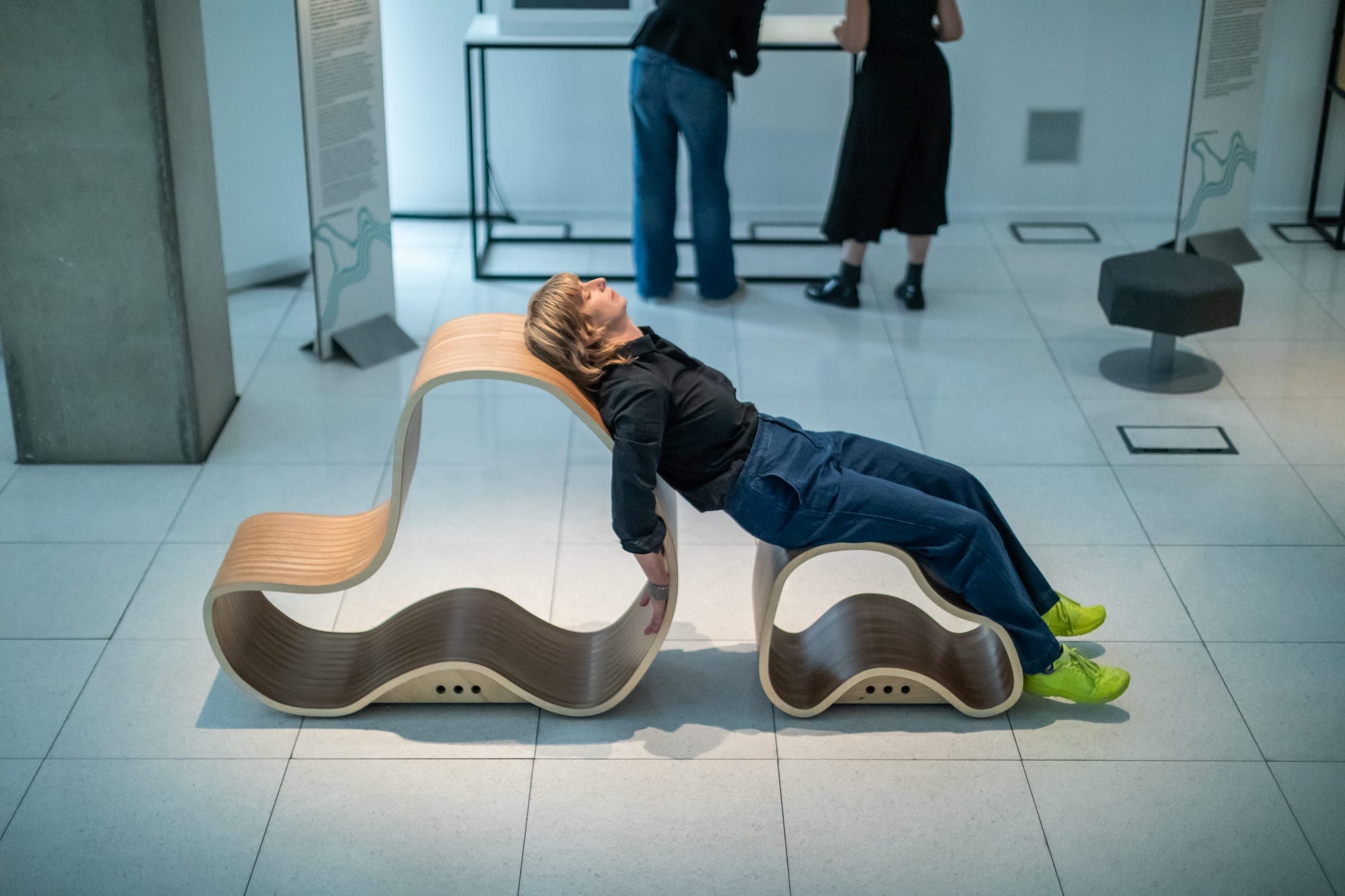
Two forces drove Julie's significant change of direction. Post-pandemic isolation had left her wanting touch in her work. A Modern Art Oxford commission, which would share gallery space with other artists, made her uncomfortable about layering soundscape over other work. The constraint produced the solution: organic wooden forms people could hold, with sound embedded in the sculptures themselves. After a career discussing the intangibility of data, physicalising it felt transformative. The playfulness mattered, too. Visitors felt permission to touch sculptures they would not normally approach in a gallery.
The second force was the AI aesthetic crisis. Her style, slightly retro and informed by 1920s constructivism, had begun appearing everywhere, generated in days.
People were running out projects in a week that would take me six months or twelve months to code. I didn't really want to carry on with that path. I wanted to try something new, something that was a bit more human, that was difficult to replicate using AI.
Audiences now perceived her manual work differently, sometimes mistaking it for AI-generated output. Her response was to make work whose process and materiality remained irreplaceable. The new work creates physical, playful interaction without button-pushing, with technology made invisible despite remaining sophisticated.
The Glacier Recording and Intentional Failure
Julie's *Models of Care* project involved deliberate low-resource AI experimentation with Arctic glacier recordings. The motivation was to demonstrate creative AI use without massive resource demands. She used two very low-resource models, RAVE and MAGNET, with collaborator Anna Wozborowska, training one on eleven hours of glacier audio over six days on a local computer.
The result was aesthetic failure. The model fixated on the statistical norm of the audio, the low rumble of melting ice, and stripped out everything she had found interesting.
All of the things that I found were interesting — an ice cleaving, or a big crack, or some squeaks, these motifs and moments — it stripped them all out because essentially they're outliers to these models.
She kept the failed output in the final work. The AI version was a constant rumble. The human compositions had variation. The AI version turned out to be the one young children preferred, because it stayed steady and vibrated intensely. The experiment served its conceptual purpose, raising the awareness that the growth of AI sits at odds with any serious route to net zero.
Process as Irreducible Creativity
Asked why she would not use AI to accelerate creative refinement, Julie articulated her process-centred philosophy directly.
I find that when I'm writing, I don't always know what I'm going to write until I've started writing. If I skip that bit out of my creative process, how do I necessarily know that the things that would have come out during that process still come out if I'm using a shortcut?
Her method rarely involves having everything laid out before making begins. The process is part of the creativity. If chunks are farmed out to AI, what comes back might be interesting and refinable, but it might also miss where she would have arrived through the labour itself. There is something about giving yourself the time, she observes, that turns the concept and settles it in.
The personal stake is clear. She loves sketching and iterating. She does not want to farm that out, because that is part of what she loves doing. The journey within the creation matters as much as the work itself.
Living Systems Yes, Computation No
Julie draws a careful distinction on authorship. In past work, she has prescribed authorship to the living systems she works with. The naked mole rat colony she has worked with for years is, in her account, a collaborator, because without them there would be no data and no work. The framing matters. Her works are open systems requiring living things, climate data, or natural phenomena to complete them. There is genuine co-ownership in that sense.
The line falls before computation.
I don't often prescribe that co-ownership or authorship to the algorithms, whether that's AI or Alife or any other stuff. I don't see that.
Even with sophisticated commercial systems, she sees the authorship as belonging to the animations the model has been trained on, not to the system itself. Computation has no intention to make art. Thirty years of programming will not let her see otherwise.
Mirroring Thinking and a Bounded Excitement
When the conversation reframed partnership as creative symbiosis rather than tool use, Julie's resistance softened.
Imagine if something knew my entire body of work, all of the different technologies I used within it, understood the timelines, the collaborators. That would be such a joy, because I can't remember very much about anything at the moment.
The ideal partnership, in her account, would recognise repeated patterns, flag where she was retreading her own ground, and surface technical possibilities for the new work. The reservation remained around nuance, humour, and the unspoken context of personality. The system would not know which conversations were serious and which were silly. It would risk folding the silly in as if it were the work.
She offered a different framing for the technology itself, borrowed from a recent podcast. Not artificial intelligence, but mirroring thinking. The system as a magic mirror that reflects an expanded version of one's own thought back, rather than something that pretends to think on its own. The word intelligence carries too much weight. Mirroring does the work the technology actually does, with less of the inflation.