
Joyce Ng (alsoguppyme)
Creative director and brand communications lead; visual artist
- Background
- Classical painting training; thirty years of commercial design experience; leads AI design workflow development at a tech company
- Current Focus
- Raw, non-traditionally beautiful personal work, while maintaining commercial polish in her day role
Executive Summary
Joyce Ng's creative journey maps a path many artists recognise but few discuss openly. The strategic surrender of artistic aspiration to economic necessity, followed by decades of negotiation between commercial demands and creative hunger. Trained as a classical painter, she pivoted into commercial design by approaching boutique agencies with her fine art portfolio and an audacious proposition: hire her at a fraction of what they paid the rest, and she would learn on the job. They took her in. Thirty years later, she leads creative and brand communications for a tech company while maintaining a personal practice that pursues the opposite of everything her day job demands.
Her AI integration began not through curiosity but through organisational crisis. When tech industry restructuring eliminated team members in 2022, she turned to AI as a survival strategy. What started as individual coping became institutional infrastructure. She now shapes how her entire organisation approaches AI-augmented creative production. Through sustained engagement, her language about AI shifted.
I started with calling AI a tool, but I think that's downplaying it. I do have a lot more respect for it. It's feeding me with new ideas.
Three tensions run through her practice without resolution: commercial necessity versus creative nourishment, AI as tool versus something harder to name, and the gap between work she finds meaningful and work that generates audience response. She knows the formula for likes and followers but resists deploying it. Her recent work has widened in view, addressing systems, surveillance, and power, and she has been more aware of how that work is read and mistaken in the process.
From Survival Strategy to Institutional Role
Joyce's AI adoption began in 2022 not through enthusiasm but through necessity. Restructuring had reduced her team while expectations remained the same. The initial motivation was not to improve the organisation but simply to cope with the workload using fewer people.
She distinguishes herself from early adopters. Midjourney had existed for four or five years before she engaged with it. Her entry was pragmatic. But the experimentation snowballed, and before long she was establishing AI workflow in design across her entire organisation, translating emergency-adoption experience into systematic practice others could learn.
Her commercial tool suite, including Midjourney, Luma, Stable Diffusion, and Runway, centres on a practical transformation: replacing photo shoots and stock licensing with custom AI-generated imagery specific to product brands. The ability to generate custom assets creates aesthetic flexibility previously constrained by production logistics and budget realities. What began as a survival mechanism became, over time, a position of organisational expertise that placed her at the centre of how her company makes things.
AI as More Than Tool
Through sustained engagement, Joyce's conceptual relationship with AI evolved. Her self-correction mid-sentence is revealing.
Sometimes because I'm a very visual person, it may just be random generation of images to get some sort of response, as though the tool that I'm working with — it's not a tool. I take that back. I shouldn't use the word tool.
What she settles on is relational framing. AI responds, generates dialogue, participates in exchange. Random generation becomes conversational, with images thrown back and forth, unexpected responses shaping direction. The relationship is more than instrumental execution and not quite partnership. It requires ongoing conceptual negotiation.
Her creative process reflects this. Traditional starting points remain, ideas, fragments of thought, things creating tension. But AI disrupted linear workflow. The starting point can now be the middle of a project, or an experiment that spawns a separate one entirely. A splinter from an unexpected generation can become a new trajectory. The fixed workflow dissolves into something more fluid and opportunistic.
One feature proved particularly generative: a blending tool that merges two video clips in unexpected ways.
It's showing me things that I've never thought I could imagine or see. This is a gift from a hallucination.
These surprises help her build what she calls a new visual language, the kind of result that would not have emerged through conscious design alone.
The Split Practice and What Feeds What
Joyce's most revealing insight concerns how commercial and personal practice inform each other through contrast rather than continuity. The day job operates under a strict aesthetic regime: polished, pixel-perfect, professionally toned. Every pixel has to be in place. Her personal work, represented by the platform Fellowship, pursues opposite territory. Raw, not traditionally beautiful, resisting surface perfection.
The paid job and the personal endeavour creates that balance and feeds off each other. Stories for personal work come from the day job.
Commercial constraints and compromises generate material for personal exploration. Client frustrations seed artistic questions. Professional limitations create desire for aesthetic freedom. This reciprocal nourishment prevents common creative casualties on both sides. Commercial work does not become soul-deadening drudgery. Personal work does not become self-indulgent. The commercial discipline grounds experimental impulses, and the experimental freedom prevents commercial practice from calcifying into mere execution.
She draws a parallel to her classical painting training. Mark-making was instinctive, bodily, borderline chaotic. Plotting this over to the AI era, she sees a parallel between the iterations that come out of generation and the marks of a brush. The discipline of mark-making, in either medium, lies in attention rather than volume. Without self-aware questioning, it becomes an act of senseless repetition.
The Formula She Knows but Resists
Like many thoughtful practitioners, Joyce recognises a troubling bifurcation between what generates engagement and what feels creatively meaningful.
I know what I generate if I really want a lot of likes and followers. I know the formula. But the stuff that I really like — the followings and the views plummet.
This creates a strategic dilemma without clear resolution. She understands performance formulas while resisting their deployment. She is conscious that AI excels at generating commercially polished output, the aesthetic of professionalism, but that this polish can eradicate personal quirks, individual signatures, the idiosyncrasies that make work distinctively human.
When the conversation turned to a similar experience with AI-generated music sounding too commercial, too unlike a personal signature, Joyce responded with recognition. The personal quirks, she said, are what make work relatable and human. Both modes can be served. They cannot easily be reconciled inside the same piece of work.
On Voice, Reading, and Male-Coded Territory
Joyce grew up in a matriarchal household and believes in giving voice to those who do not have one. She has never been drawn to labels, in her account, because labels do not tend to steer the work. What she has noticed more recently is something else. Her recent work has ended up in male-coded territory, addressing systems, surveillance, and power, and has been mistaken for a man's work. She had not quite examined that until recently. She is more aware of it now.
The practice has not shifted, but the view has widened. When she addresses systems now, it is not only what she observes from the outside. It is also what she knows from living inside them. The vantage matters. The work reads differently when the artist is recognised, and differently again when she is not.
Intimacy, Dependency, and the Five-Year Wish
Joyce articulates something unusual about her relationship with AI.
I've never been so intimate with a non-being. This is literally a tool which I am sharing some most personal thoughts and prompts with. The fear is that it's an AI after all. Giving too much, leaning onto it too much, is also very risky because I don't own the app.
This intimacy-with-risk captures her ambivalence precisely. She has developed genuine creative dependency on something she does not control, whose terms of service can change, whose aesthetic tendencies she has learned to navigate but cannot fully trust.
Asked to imagine creative practice five years forward, she offers a vision that is less about returning to anything than about remembering what we already are. We are sensory beings. Digital consumption is one channel, not the whole bandwidth. We were given bodies, and they work as instruments too. The wish is not to undo AI. The wish is for people to remember to use everything they were built with.
What makes artists different in the age of AI, she concludes, comes down to curation and intent.
AI is so accessible. Another creator can pump in the same prompt and yield the same results. What makes them different from me? It all boils down to the curation and the intent — what the other person is trying to say.
The tools are democratised. The judgement behind their use is not. Joyce's practice suggests that in a world where everyone can generate, the question of what is worth keeping, and why, becomes the work itself.
Selected Works
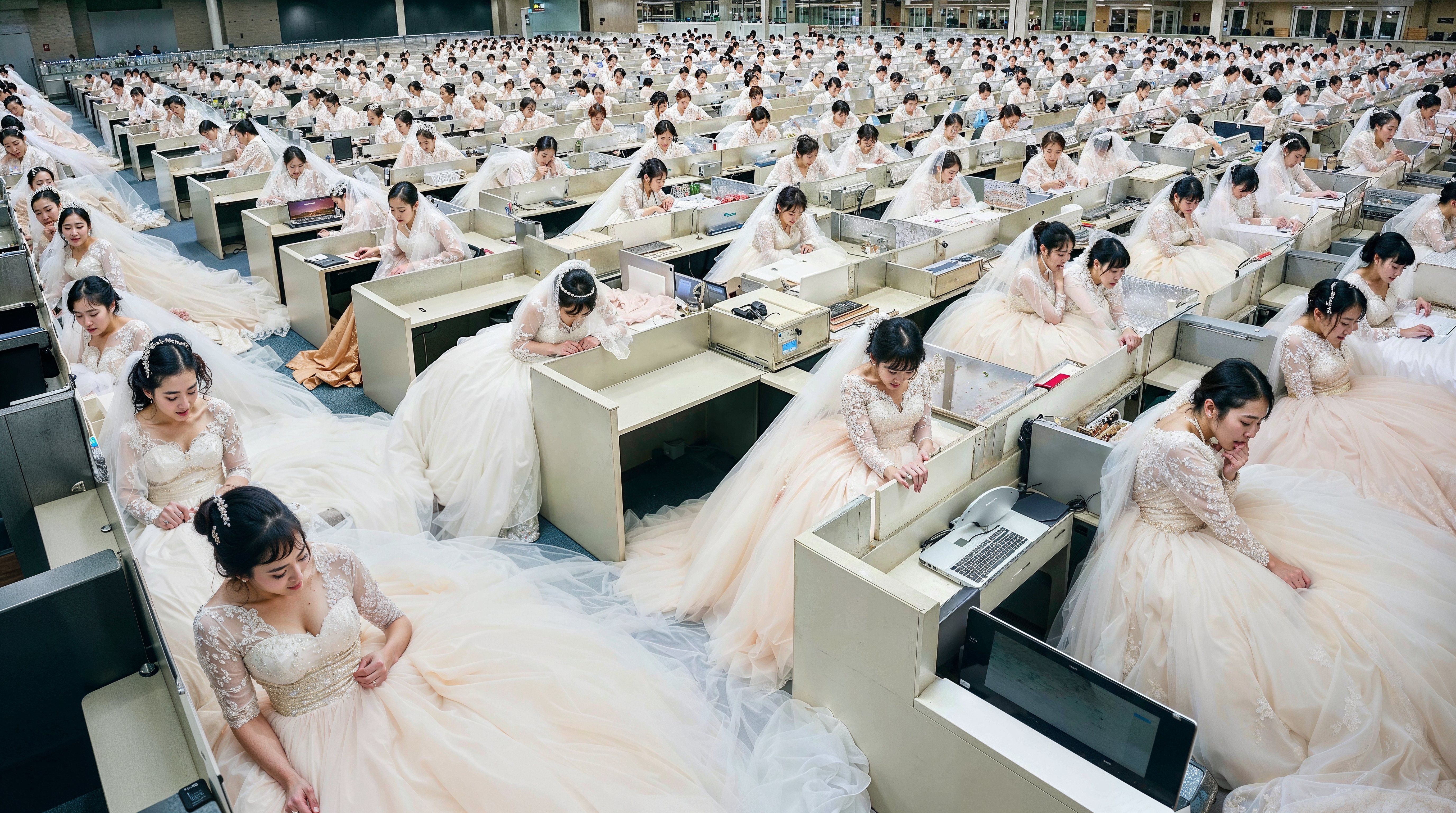
Till Shift Do Us Part is a piece Joyce was proud of at the time. Looking at it now, the prettiness undermined the critique. The geometry, the dresses, it made it too easy to look at. The tension got lost in the beauty.
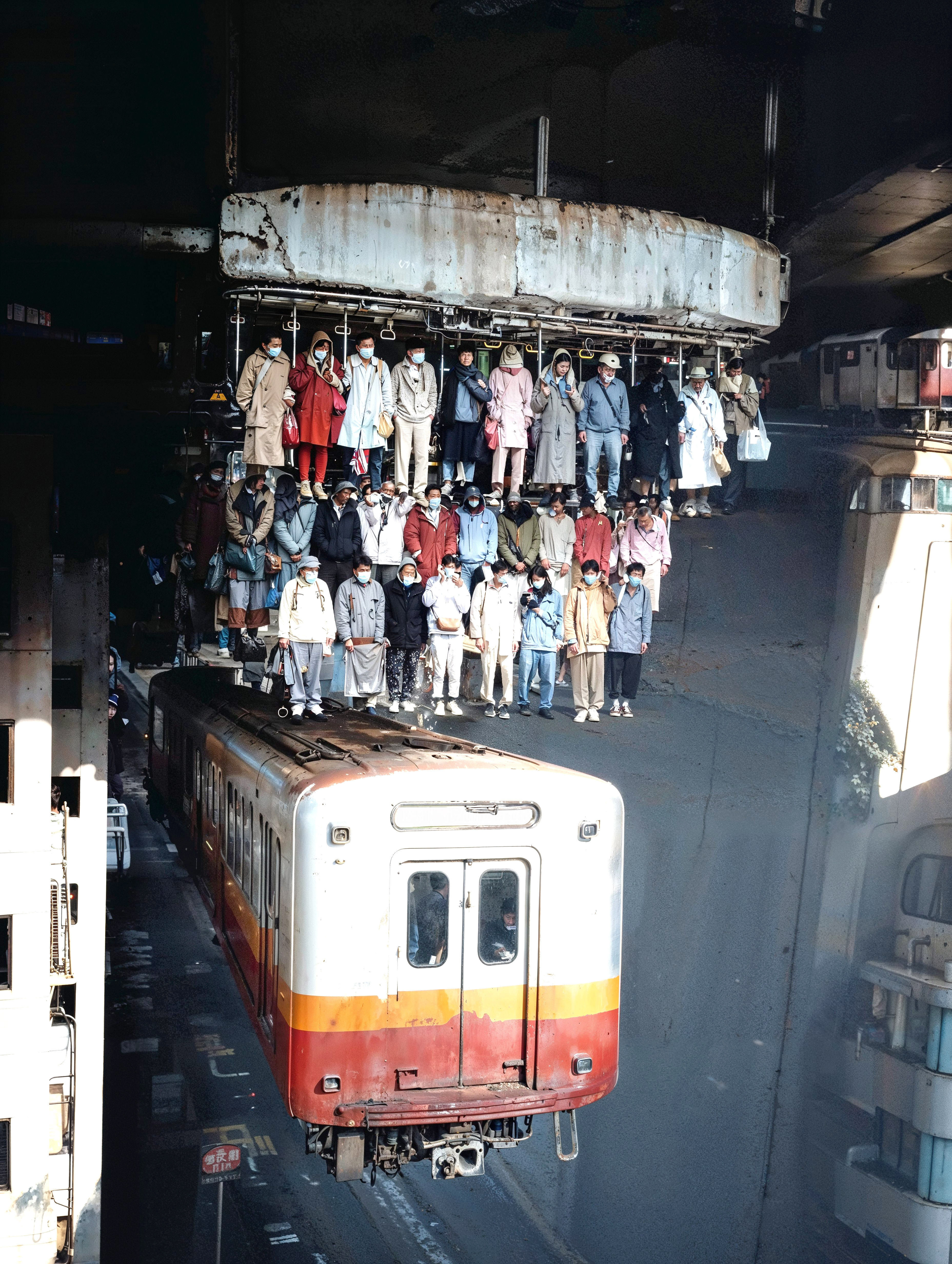
Under the Wire was the turn. It covers something dear to her: endurance. It is raw and gritty and it does not ask for your approval. That is the one she feels most proud of, until time decides to betray her.