
Jane Prophet
Artist and academic
- Background
- Electronic arts since 1989; conceptual art training; computational media, bioart, and science-art collaboration
- Current Focus
- AI generative video (herbAIrium, 2024); critical engagement with AI normativity
Executive Summary
Jane Prophet approaches AI through conceptual art principles absorbed in 1980s training with Art & Language practitioners, exploring the material qualities of media rather than using them instrumentally. This framework, applied consistently across thirty-five years of computational practice, shapes her distinctive AI methodology. The question is not what she can make with the tool, but what is going on with the technology itself.
Her breakthrough came when she abandoned attempts to control AI outputs and instead embraced call-and-response: observing what the system returned, responding to that, and allowing both artwork direction and technology behaviour to shift through mutual interaction.
I realised it was about call and response. Not to try necessarily to improve the output and make it closer to my storyboard, but rather to change the direction of the artwork to address how the technology is behaving.
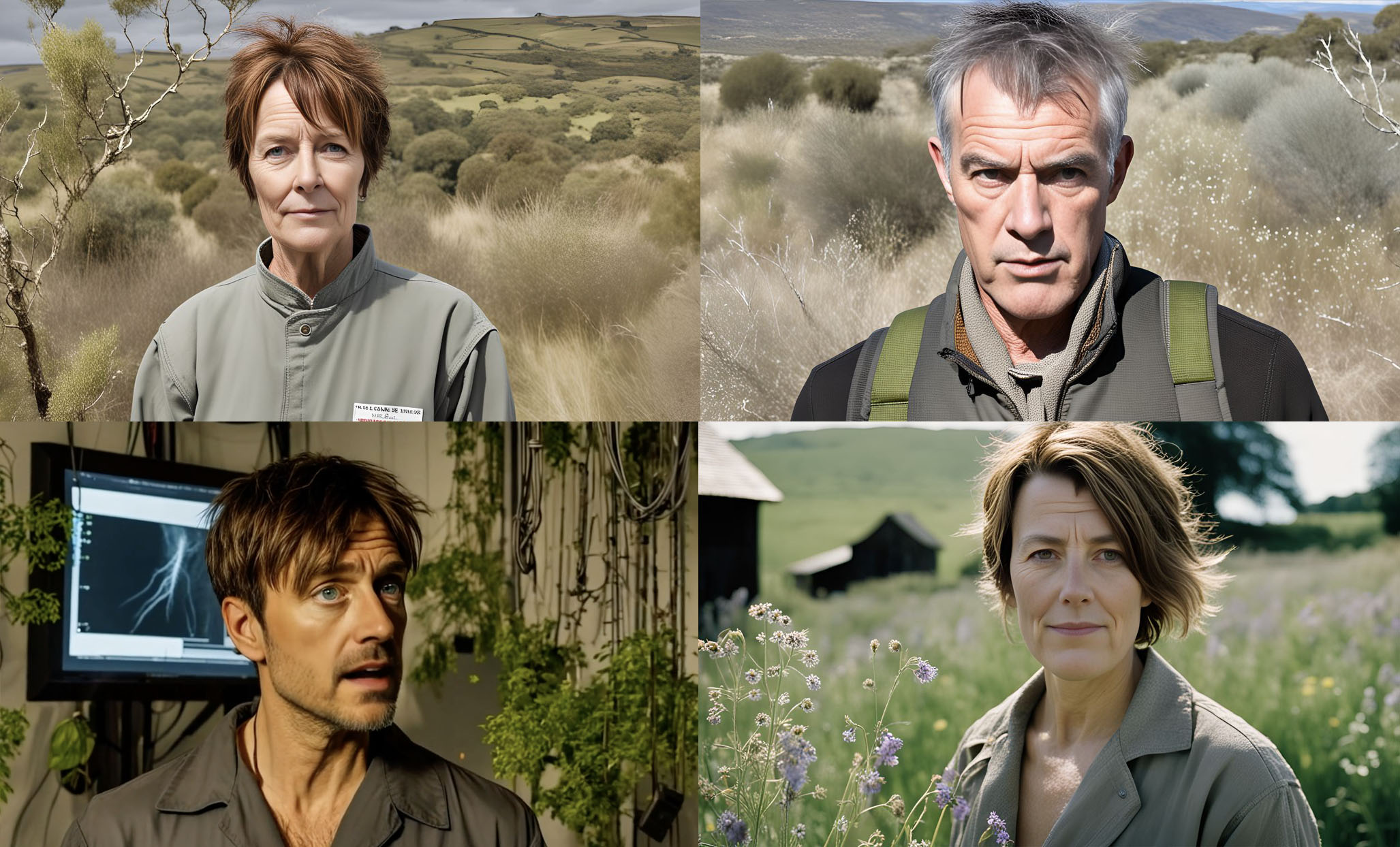
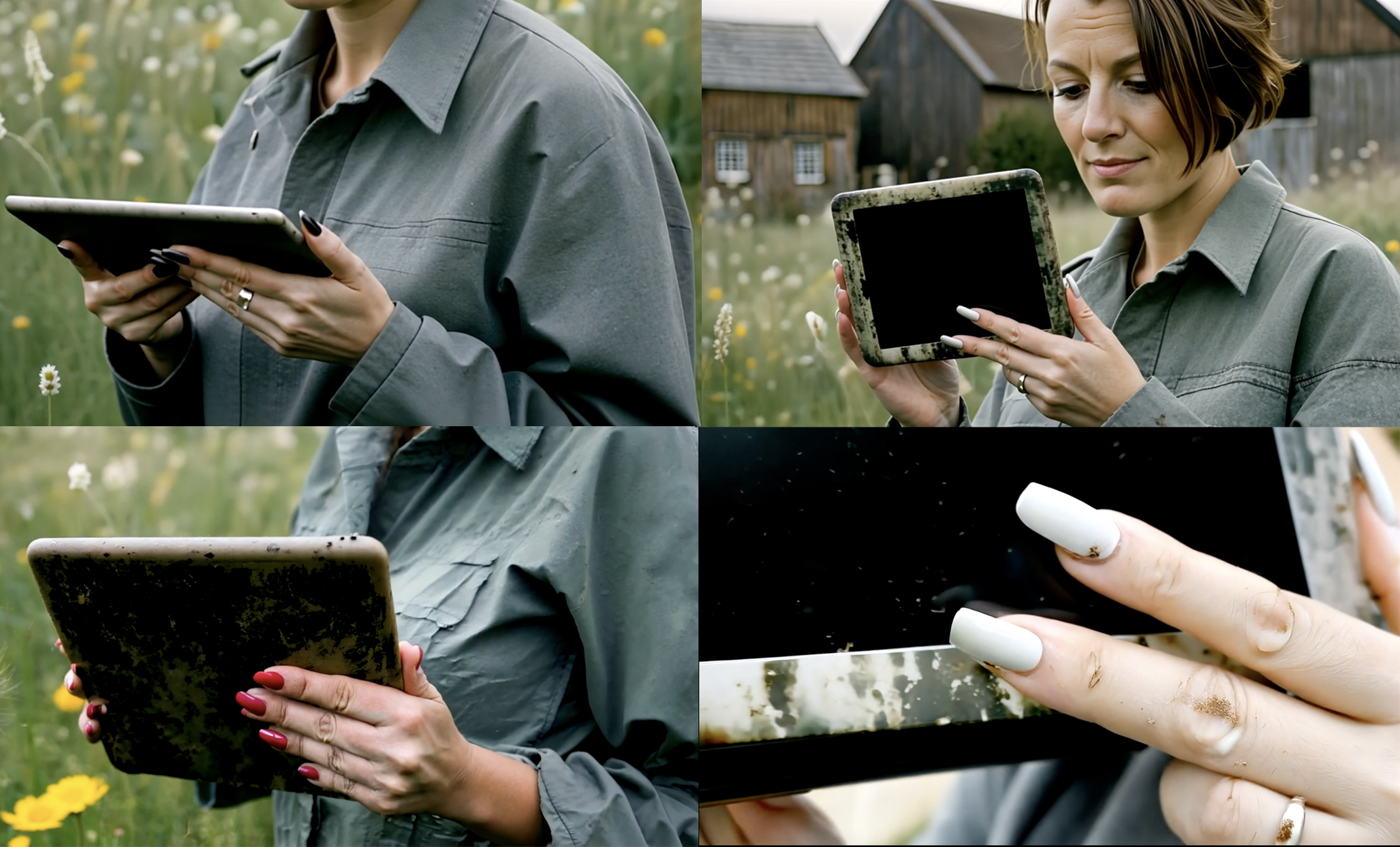
Through seven weeks of intensive work with Runway, she systematically documented the system's normative biases: curvaceous bodies, blue eyes despite brown-eyed training images, manicured hands with wedding rings. Rather than abandoning AI, she incorporated these constraints into the work itself. Her four-minute video herbAIrium explicitly deconstructs the experience of making with AI, turning limitations into content.
She also expresses something unexpected: nostalgia for AI's earlier randomness. As systems become more controllable and predictable, the surprising tangents she found most generative diminish. For practitioners who value AI's capacity to resist and surprise, increased controllability becomes a creative limitation rather than an improvement.
From Control to Call and Response
Jane's December 2023 experiments with Midjourney and Runway failed because she approached the technology instrumentally, writing prompts for specific outputs and receiving low-resolution, clichéd images. The experience paralleled her 1989 frustrations with 3D modelling, when rendering engines assumed everyone wanted photorealistic chrome. Back then she would have an idea of something subtle and diaphanous, and end up with a multifaceted, cubular, shiny object she had not asked for. She abandoned AI for months.
The reorientation came in September 2024. Attempting to create a science-fiction video about a botanist discovering alien plants, she found it pretty much impossible to reproduce storyboard shots in Runway. The system's slow generation process prompted a different question. What were the material qualities of this technology? What was actually going on?
The shift was fundamental. Rather than fighting toward a predetermined vision, she began observing what came back and responding to that. AI transformed from a frustrating tool into a conversational partner where both parties adjust based on the other's responses. The artwork direction was no longer fixed in advance. It became something she developed through the dialogue itself.
Documenting AI's Normative Biases
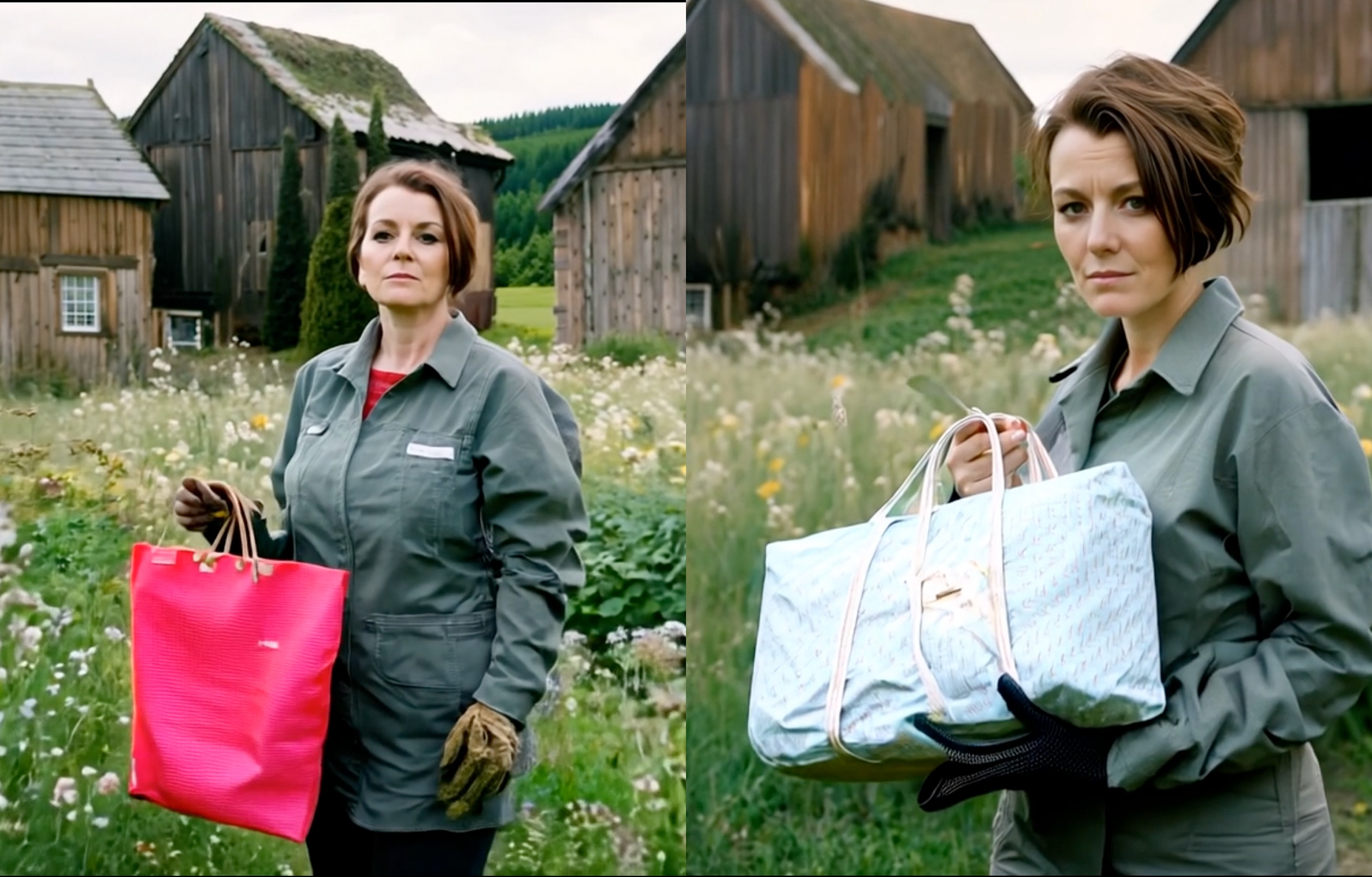
Through seven weeks of intensive work, Jane systematically documented what AI defaulted to. Training a custom character on her own images, the system consistently produced curvaceous bodies in tight jeans even when she prompted for baggy jeans, blue or green eyes despite training on brown-eyed images, and perfectly manicured hands with wedding rings for any fem-gendered character. Attempts to specify "small-breasted" triggered content filters that could not distinguish anatomical description from sexualisation. Her skin tone, she observed, was not a problem, presumably because it was white.
Most philosophically challenging was AI's inability to accept negative prompts.
Just how much of who I am or how I would define a character or a place is about what isn't in there. You can't erase. You can't say no. You can only say yes.
The inability to say no carries a particular weight that is hard to ignore. The constraint reads as gendered the moment you sit with it, since the negotiation over refusal is one women navigate in many other domains. Rather than abandoning the work, Jane incorporated these constraints into it. For the manicured hands, the only workaround was to put gardening gloves on them, and that workaround became part of herbAIrium. The resulting video does not pretend AI transparently serves her vision. It deconstructs the experience of making with AI, making the negotiation between artist and system visible. The normative biases, the prompt frustrations, the workarounds; all became content.
Discord Ethnography and the Cost of Hoarded Prompts
Jane's intensive work included active Discord participation, not just to solve her own problems but to understand how others were using these tools. Many users sought production efficiency: speeding up shoots, reducing costs, working around skill gaps. For these users, prompting was a means to an end. For Jane and a smaller group, prompting was part of the creative process itself, including the cognitive labour of learning what the system could and could not do.
She observed something corrosive about the economic structure. Users would not share prompts in help threads because the prompt was the value, the source of competitive advantage. This proprietary hoarding made collaborative problem-solving impossible. Sometimes you could not help people because they would not share what they had asked. The gift economy that has historically characterised many creative communities does not survive when the product itself sits in the prompt.
Nostalgia for Randomness
I have a slight nostalgia for Runway of late '24 because it was so out there. Some of the images that came back would really prompt me. I'd start to think differently about the core idea I was engaging with. Now there's less of that.
She made sequences in autumn 2024 that captured an idea precisely, and which she could not repeat. Now, with video reference features, repeatability is possible, which serves production needs but eliminates generative unpredictability. Technical advances have focused on camera control and human subject representation, both of which she considers secondary to her concerns. She increasingly wants no camera movement at all, but getting static cameras proved very hard until recent updates.
This reveals a tension running through AI development. Improvements toward user control often diminish system agency, the capacity to surprise, resist, and propose alternatives. For practitioners who value AI's non-compliance, increased controllability becomes a creative limitation rather than a step forward.
Collaboration Versus Assistance
I think you can use AI to make creative things, treating it as a tool. But most of the image generation work I would say is more collaborative. Sometimes I prompt something and what I get back is not what I expected, but it's interesting. Let's go. Let's do more.
When she gets something unexpected, she wants to understand it. Productive disagreement, investigating why the system did something rather than treating it as malfunction, is what makes the work feel collaborative. By contrast, when she is repeating something with a set idea, asking for a different plant in a sequence or adjusting a leaf shape, the work becomes assistive. The idea is fixed. She is essentially asking the system to do the same thing again with minor variation.
She also notes the system's quirks. AI feels stubborn at times, and very sycophantic, constantly affirming whatever response she gives. The performative agreeableness reminds her of a bad therapist. A good therapist, she points out, would ask why she was behaving that way, rather than telling her she had answered the question beautifully.
Dataset Politics and the Alt Text Revelation
Jane identifies dataset construction as a crucial intervention point. Her big revelation was that what matters most is not the images a database is trained on, but the alt text that accompanies them, something most image-makers are unaware of. Research reveals that even when images are safe for work, the alt text can be highly racist, pornographic, and ableist. The LAION dataset, she notes, is full of this kind of material.
Her proposal, if she could influence platform development, is for different communities of interest to create the next dataset, deciding which images and which alt texts go in and what the alt texts say. This shifts power from centralised corporate decisions to distributed community governance, a feminist technoscience position recognising that technology reflects the positionality of those who build and clean it. The labour of dataset cleaning remains almost invisible, and the values encoded into datasets travel into every output the model produces.
Critical Engagement Over Refusal
Jane's most forceful argument concerns engagement versus refusal. A curator visiting her solo show became absolutely triggered after reading wall text describing her AI use, asking whether she was completely in support of AI and, most tellingly, whether the work was even art. She was struck by how familiar the question felt.
She draws an explicit parallel to the 1990s, when computational art existed in what she calls a new media art ghetto, shown only in specific venues, discouraged from mainstream contemporary art. The conversation she found herself having in the gallery sounded eerily like the conversations of three decades ago.
I don't believe a positive solution is for me or other creative people to refuse to engage. We've got to be in the tent. We can be in our own gang in the tent, but we've got to be part of the discussion.
Refusing participation does not stop AI development. It only removes critical perspectives from decision-making at the moment they are most needed. Artists do not need to write algorithms themselves, in her view. They need to be in conversation with those who do, because conversations can change the algorithm. Thirty-five years of working alongside life scientists has shown her that those exchanges change practice on both sides, sometimes in ways neither party could have predicted. The question for AI is the same. Stay in the tent, push from inside, and treat the technology as a material worth investigating rather than a force to be celebrated or resisted.